
Home buying guide
Which coffee grinder is right for your home?
The grinder matters more to the taste of your coffee than anything else on the worktop, including the machine. Freshly ground beans taste noticeably better, and an even, adjustable grind is what lets you make the same great cup every morning. This guide helps you pick the right one for your kitchen in about five minutes.
Ground coffee starts losing its aroma within minutes, which is why the bag of pre-ground from the supermarket never tastes like the café. Espresso needs a grind four times finer than a cafetière, adjusted in tiny steps. The right grinder depends on how you brew, and it matters more than the machine.
Grinder finder
Answer five questions
Your recommendation updates as you choose. We've filled in a typical home espresso answer to start you off.
The home grinder types
Every home grinder falls into one of these
Prices are typical UK retail ranges. The biggest divide is between grinders that can go fine enough, in small enough steps, for espresso, and those that can't. The second is whether you keep beans in a hopper or weigh each dose fresh.
Side by side
How the types compare
| Type | Grind quality | Espresso ready | Speed & ease | Quietness | Best for |
|---|
Five dots is best in each column.
Our range
Our grinders
We specialise in single-dose grinders for the home: you weigh what you'll brew, grind it all, and nothing is left behind to go stale. Every one of these goes fine enough for espresso and coarse enough for cafetière, with stepless adjustment in between.
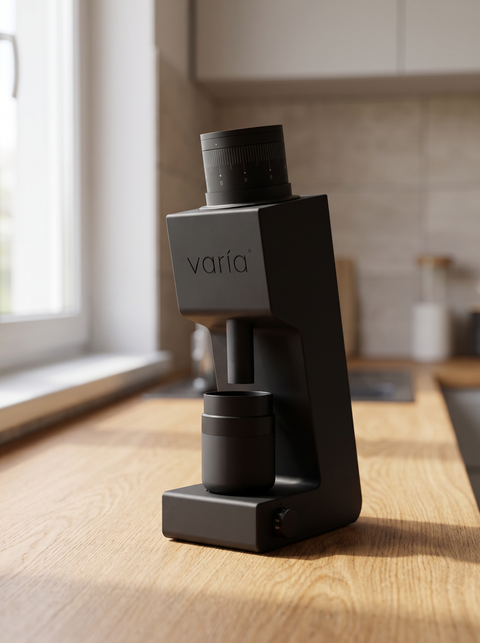
Single-dose conical burr
About this type ↑Compact, quiet and forgiving, with a rounder, fuller cup. Slow-turning motors mean less noise at 6am and less heat in the coffee.

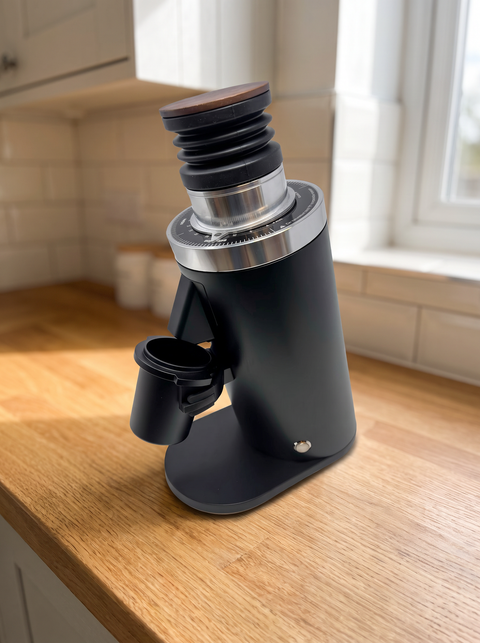
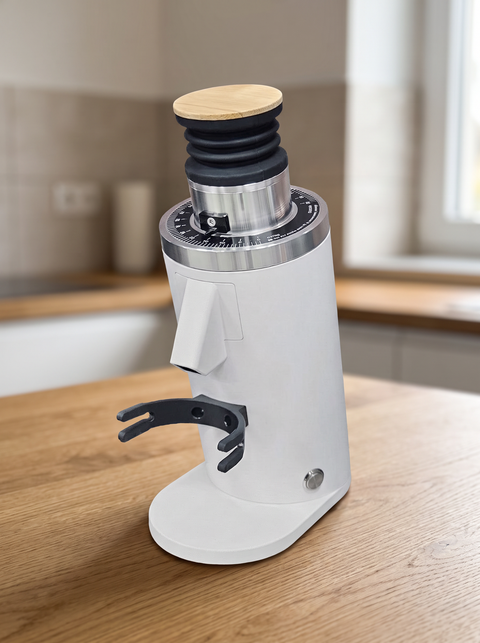
Single-dose flat burr
About this type ↑Flat burrs give the clearest, most separated flavours, which is what specialty espresso and pour-over are about. A little louder, and the first choice for lighter roasts.
Not sure between them? Tell us your machine and the beans you buy and we'll pick for you. Contact us.
Grind size guide
How fine should you grind?
Each brew method needs a different grind. The finer the grind, the faster the water extracts flavour, so short brews need fine coffee and long brews need coarse. Particle sizes are approximate.
Reading a spec sheet
The specs that matter
Grinder listings use a lot of jargon. These are the features that change what ends up in your cup.
- Burrs vs bladesAlways choose burrs
- A blade grinder chops beans like a food processor, leaving a mix of dust and chunks that brews unevenly. Burr grinders crush beans between two cutting surfaces to a set size. Every grinder we recommend for good coffee uses burrs.
- Conical vs flat burrsBody vs clarity
- Conical burrs are compact, quieter and forgiving, and tend to give a rounder, fuller-bodied cup. Flat burrs tend to give more clarity and separation of flavours, which suits lighter specialty roasts. Both make excellent coffee; this is a matter of taste, and we stock both.
- Burr size38 mm to 64 mm at home
- Hand grinders use about 38–48 mm burrs, home electrics 38–64 mm. Bigger burrs grind faster, run cooler and are usually more consistent at espresso fineness. For a household making up to six drinks a day, 38–54 mm is plenty; 64 mm is a luxury you'll enjoy.
- Stepped vs steplessAdjustment
- Stepped grinders click between set positions, which makes it easy to return to a setting. Stepless grinders adjust in infinitely small amounts, which is what you want for espresso, where a change of 20 microns is the difference between a sour shot and a sweet one.
- Retention0.1 g to 3 g
- The coffee left inside the grinder after each use. Low retention means your next dose is fresh and matches what you weighed, and you can change beans without purging. Single-dose grinders are designed to keep this near zero; hopper grinders hold a gram or more of yesterday's coffee.
- Single dose vs hopperWorkflow
- Single dosing: weigh 18 g, tip it in, grind it all. Beans stay sealed in the bag, every dose is exact, and switching between a decaf and a house blend takes seconds. Hopper grinders store beans on top and grind by time; quicker to use, but the beans in the hopper go stale and the dose drifts as the level drops.
- Motor speed and noiseRPM
- Slower-turning, geared motors are quieter and heat the coffee less. Some grinders let you vary the speed: slow for filter to reduce fines, faster for espresso. Wattage alone tells you little. If you grind before the house is awake, speed and noise are worth checking.
- Static and messPlasma · RDT · bellows
- Fine coffee clings and scatters. Some grinders have a plasma generator (an ioniser) to neutralise static; otherwise a single spray of water on the beans before grinding, known as RDT, does the same job. Bellows push the last grams out of the chute.
Matching grinder to machine
What grinder does your machine need?
For espresso, a good rule is to spend at least a third of the total on the grinder, and up to half. A great grinder with a modest machine beats a great machine with a modest grinder every time. Not sure which machine you need? Start with our coffee machine buying guide.
Pod or bean-to-cup
Pods come pre-ground and bean-to-cup machines have a grinder built in.
Starter espresso
An espresso-capable hand grinder or a compact single-dose electric. The grinder will outlast the machine and move up with you.
PID or heat exchanger
A single-dose grinder with stepless adjustment and 50 mm+ burrs, so the grinder isn't the weak link.
Dual boiler or lever
Larger burrs, 58–64 mm, to match the machine's precision and keep up with back-to-back drinks.
Filter and cafetière
A hand grinder or filter burr grinder, or a single-dose grinder if you also want espresso one day.
Grinding at home
The routine, and how to make it painless
- Weigh, don't guess. A £15 set of 0.1 g scales turns every shot into a repeat of the last good one. Dose 18 g for a double, aim for 36 g in the cup.
- Dial in once per bag. Grind, pull, taste. Too fast and sour: finer. Too slow and bitter: coarser. Two or three shots and you're there for the rest of the bag.
- Keep beans in the bag, not the grinder. Single-dose grinders let you store beans sealed and grind only what you need. Beans are best 7–30 days after roasting.
- Mind the height. Most single-dose grinders are 30–34 cm tall; allow room above to drop beans in under a wall cupboard.
- Early-morning noise. Grinding 18 g takes 8–15 seconds. A slower, geared conical grinder is noticeably quieter than a high-speed flat one.
- One grinder for both. Switching between espresso and filter is a 20-second adjustment on a stepless single-dose grinder. Note the setting for each and you'll never hunt for it.
Care and cleaning
Keep it grinding well
- Brush out the burrs and chute every week or two to remove old coffee and oils.
- Use grinder-cleaning tablets once a month. Don't use rice, which can damage burrs and motors.
- If you have a hopper grinder, keep only a few days' worth of beans in it.
- Go easy on very oily, dark roasts in single-dose grinders if the maker advises against them.
- Never wash burrs in water unless the manufacturer says it's safe. Rust ruins them.
- Home steel burrs last many years. Replace them when grinding slows or the taste flattens.
Common questions
Quick answers
Is a grinder really worth it over pre-ground coffee?
Yes. Ground coffee loses much of its aroma within minutes and goes noticeably stale within days. Grinding fresh is the biggest single improvement most people can make at home, and for espresso it's essential, because you need to adjust the grind to get the shot right.
Why do you only sell single-dose grinders?
Because for a home, they solve the two problems that matter: stale beans in the hopper and inaccurate doses. You weigh what you'll brew, grind it all, and the grinder is empty again. They also make switching between beans, or between espresso and filter, trivial. Hopper grinders make sense in a café grinding every minute; at home, single dosing is simply better.
Can one grinder do espresso and filter?
Yes, if it is stepless and low-retention. All our grinders cover Turkish to cafetière. Note the setting for each method and switching takes 20 seconds. If you switch several times a day, some people keep a hand grinder for filter and leave the electric one set for espresso.
Is a hand grinder good enough for espresso?
A good espresso-capable hand grinder can match electric grinders costing twice as much. The trade-off is effort: grinding 18 g for espresso takes 30–60 seconds of turning, which is fine for one drink and tiresome for four.
Why is my espresso running too fast or too slow?
Grind size is almost always the cause. If the shot runs too fast and tastes sour, grind finer. If it drips slowly and tastes bitter, grind coarser. Adjust in small steps and change one thing at a time.
What's the difference between a £200 and a £500 grinder?
More consistent particle size, bigger burrs, finer adjustment, variable speed on some, and better build. At espresso fineness these differences are easy to taste, especially with lighter roasts. For cafetière or filter coffee the gap is smaller.
I'm still not sure. Can you help?
Yes. Email us at info@precisecoffee.co.uk with your answers from the finder above and the machine you use, and we'll suggest a specific grinder.
Ready to choose?
Browse the grinders we stock, or send us your finder answers and the machine you use and we'll narrow it down for you.
Still choosing a machine? Read our coffee machine buying guide.
Prices and figures are typical UK ranges and are a guide only. Check individual product listings for exact specifications.