
Home buying guide
Which coffee machine is right for your home?
Café-quality coffee at home comes down to four things: what you drink, how much of the routine you want to do yourself, how many drinks your household makes in a row, and what you want to spend. This guide works through all four in about five minutes, and tells you honestly when a cheaper machine is the right answer.
Those five numbers describe a café double espresso. Every machine on this page is trying to hit them in your kitchen. The difference between them is how much of the work the machine does, and how consistently it does it, morning after morning.
Machine finder
Answer five questions
Your recommendation updates as you choose. We've filled in a typical household to start you off.
The home machine types
Every home machine falls into one of these
Prices are typical UK retail ranges. Where a machine needs a separate grinder we've shown that too, because it's the part people forget and the part that makes the biggest difference to the cup.
Side by side
How the types compare
| Type | Cup quality | Ease of use | Speed | Cost per cup | Upkeep | Best for |
|---|
Five dots is best in each column. For cost per cup and upkeep, more dots means cheaper and easier. Speed covers both warm-up and how quickly you can make a second drink.
Our range
Where our machines fit
We only stock machines we'd put in our own kitchens: PID-controlled, 58 mm groups, built to be serviced rather than replaced. Here is the current range grouped by the types above.
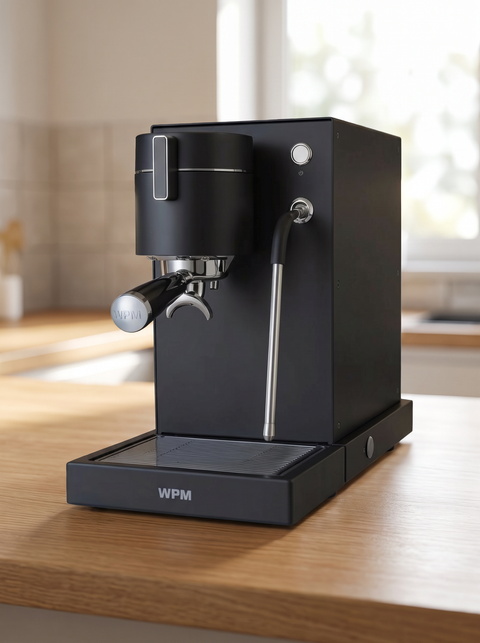
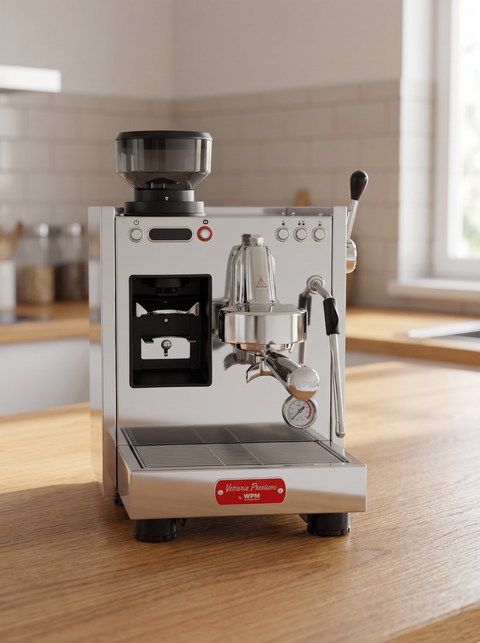
Fast-heating PID espresso
About this type ↑Ready in minutes, brew and steam together, and modern controls such as pressure profiling and touchscreens. Our pick for most daily espresso drinkers.

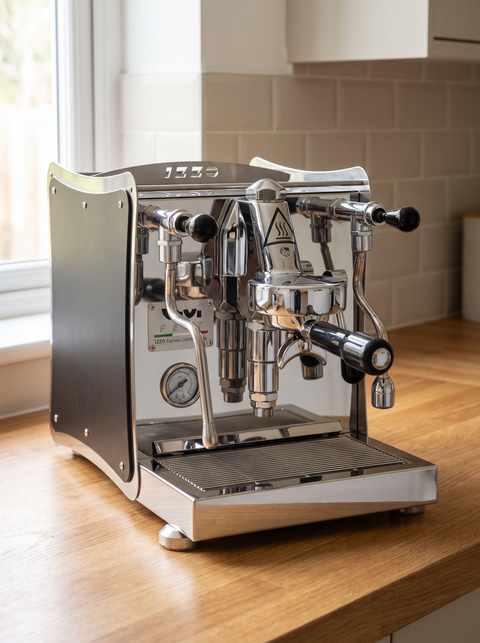
Heat exchanger (E61)
About this type ↑The classic Italian home machine. A big boiler, a heavy E61 group and strong steam. Give it 20 minutes to warm up, or put it on a smart plug.
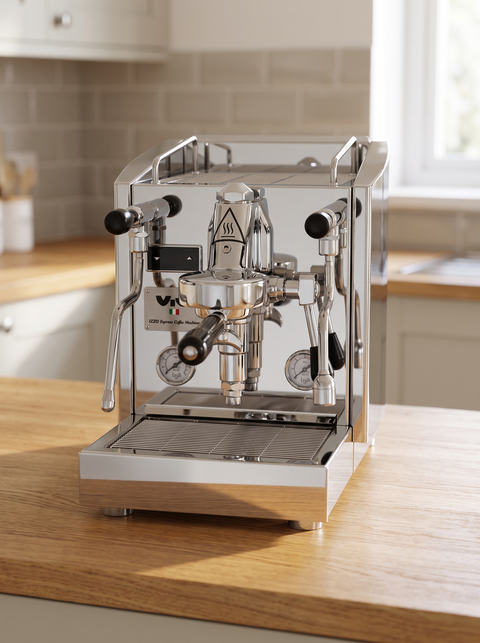
Dual boiler
About this type ↑Two boilers, two PIDs, no compromise. Set the brew temperature to the bean and steam at full power at the same time.


Lever espresso
About this type ↑Pump-free and nearly silent. You shape the shot by hand. Tall, heavy and usually plumbed in, so measure first.
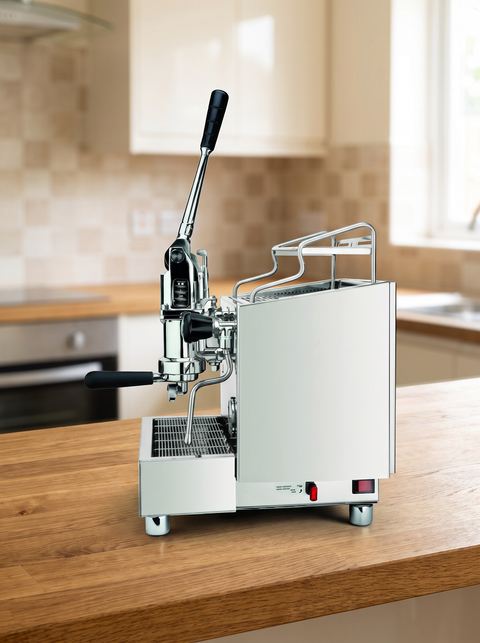
All of these run from a standard UK 13 A plug and a removable water tank unless the listing says otherwise. The Alex Leva needs plumbing in.
Reading a spec sheet
The specs that matter, and the ones that don't
Machine listings are full of numbers. These are the ones that change what ends up in your cup at home.
- Pump pressure15 bar, 19 bar, 20 bar
- Espresso is brewed at about 9 bar. The big number on the box is the pump's maximum, not what it brews at, so a 20 bar machine isn't better than a 15 bar one. What you actually want is a machine that holds a steady 9 bar, or lets you adjust it. Ignore the headline figure.
- Heating systemThermoblock · HX · dual boiler
- Thermoblocks heat water on demand: ready in minutes, and modern PID-controlled versions with a separate steam block let you brew and steam together. Heat exchanger (HX) machines keep one big boiler at steam temperature and heat brew water on the way through, with a quick cooling flush before each shot. Dual boiler machines have separate brew and steam boilers, each at its own set temperature, which is the gold standard for back-to-back milk drinks.
- PID temperature control±0.5 °C
- A digital controller that holds brew water at the temperature you set, instead of swinging around a thermostat. It is the single biggest upgrade for consistent espresso and the reason a lighter roast can taste sweet rather than sour. Every machine we sell has one.
- Group headE61 · saturated · 58 mm
- The part your portafilter locks into. The E61 is a heavy brass group from 1961 that holds temperature beautifully and pre-infuses mechanically. Saturated groups are flooded with boiler water and heated electrically. 58 mm is the café standard with the widest choice of baskets and accessories; smaller sizes work but limit upgrades.
- Pre-infusion and profilingFlow · pressure · time
- Pre-infusion wets the coffee gently before full pressure, which forgives small mistakes in grinding and tamping. Pressure or flow profiling lets you change pressure during the shot, which is how you get the best from light roasts and the richest from dark ones. Nice to have, not essential: a steady 9 bar makes superb coffee.
- GrinderThe half you can't skip
- Fresh, even grinding matters more than the machine. For any machine with a portafilter, budget at least a quarter of the total for the grinder, and ideally half. A built-in grinder saves worktop space but is harder to upgrade later. Read our grinder buying guide or see our grinders.
- SteamWand · pressure · tip
- A steam wand is what makes silky microfoam for flat whites and latte art. Dry, powerful steam from a boiler textures a jug in 20 seconds; a thermoblock takes a little longer. Cool-touch wands stop milk baking on and save your fingers. Automatic frothers are easier but the texture is never as good.
- Pump typeVibration · rotary · gear
- Vibration pumps are standard on home machines, compact and buzzy. Rotary and gear pumps are much quieter and hold pressure more steadily, and gear pumps allow fine pressure control. If the machine sits in an open-plan kitchen or you make coffee before the house is awake, a quiet pump is worth paying for.
- WaterTank · plumb-in · hardness
- Home machines run from a removable tank of 1.5–2.5 litres, which is plenty for a household. Some can be plumbed in if you have a coffee corner near a water feed. Most of England and Wales has hard water, and limescale is the number one cause of machine failure, so plan for a filter in the tank or filtered water and a descaling routine.
- Warm-up time5 to 25 min
- Thermoblock machines are ready in around five minutes. E61 heat exchanger and dual boiler machines take 20–25 minutes to heat all that brass. Most households put them on a smart plug timer so the machine is hot when the alarm goes off, which turns the longest warm-up into no wait at all.
Running costs
What a cup actually costs at home
The machine is only part of it. Here's the approximate coffee cost per drink, before milk, and what that adds up to for a household making three drinks a day.
Pods / capsules
Branded capsules sit at the top, compatibles lower. At three a day that's roughly £380–£650 a year, more than the price gap to a bean machine.
Fresh beans, espresso
A double shot uses about 18 g of beans. At £15–£30 per kilo from a good roaster, that's £270–£600 a year at three a day, and the coffee is in a different league.
Filter coffee
About 15 g of coffee per mug. The cheapest way to drink very good coffee if nobody in the house wants milk drinks.
Also budget around £20–£60 a year for water filters or descaler, a tub of group-cleaning powder for espresso machines, and milk-system cleaner for bean-to-cup. A café flat white in the UK is now £3.50–£4.50, so a household that buys two a day can pay for a £1,500 set-up in well under a year.
Setting up at home
Fitting a serious machine into a real kitchen
- Measure height with the lid open. You fill the tank from the top on most machines, so check the gap under wall cupboards, not just the machine's height. Levers are tall; some need an open counter.
- Depth with the drip tray out. E61 machines are 40–45 cm deep. Allow room to slide the tray and tank out without moving the machine.
- Power is simpler than you think. Every machine we sell runs from a normal 13 A socket. Avoid extension leads and don't share a socket with the kettle on the same run.
- Check your water. Look up your postcode's hardness with your water company. Over about 150 ppm, use a filter cartridge in the tank or a jug filter, and descale on the maker's schedule.
- Think about noise. A vibration pump and a grinder at 6am travel through an open-plan house. Rotary or gear pumps and a quieter grinder make a real difference.
- Put it on a timer. A smart plug that switches an E61 machine on 25 minutes before you get up costs £15 and removes the only real drawback of a boiler machine.
Before you buy
Six-point checklist
- Measure the space: width, depth with the tray out, and height under cupboards with the lid open.
- Add the grinder, a 58 mm tamper, a milk jug, scales and a knock box to the budget if you're going manual. Ask us for a bundle price.
- Decide how you'll make milk drinks: steam wand, automatic system, or none at all.
- Check your water hardness and plan for a filter or regular descaling from day one.
- Think about your busiest morning, not your average cup. Two people wanting flat whites at once is the test.
- Read the warranty and check that spare parts and servicing are available in the UK. Everything we sell can be serviced here.
Common questions
Quick answers
Is a bean-to-cup as good as a proper espresso machine?
No, but it is close enough for many homes. A PID espresso machine with a good grinder, used with a little care, makes coffee that matches a good café. A bean-to-cup makes a very decent drink with no skill and no mess. If you'd rather press a button than learn a routine, buy the bean-to-cup and enjoy it. If you'd like the ritual and the best possible cup, go manual.
Do I really need a separate grinder?
For any machine with a portafilter, yes, unless it has one built in. Pre-ground coffee goes stale within days and can't be adjusted, which makes good espresso almost impossible. Our grinder guide explains what to look for; our range starts at around £215.
Should I just buy a pod machine to save money?
If you drink one coffee a day, a pod machine is sensible and we'll happily say so. At two or more a day the pods cost more per year than the gap in machine price, and a bean machine pays for itself within a year or two while making much better coffee.
Heat exchanger or dual boiler?
If most of your drinks have milk and you make them back to back, both work. A dual boiler lets you set the brew temperature exactly, which matters if you buy lighter roasts from specialty roasters. A heat exchanger is simpler, usually cheaper and has superb steam, but you do a short cooling flush before each shot. Dark and medium roasts are very happy on either.
How long does a home espresso machine last?
Pod machines typically last 3–5 years. Bean-to-cup machines 5–8 years with regular cleaning. A well-built E61 or dual boiler machine is a 15–20 year purchase, because every part can be replaced. Buying a serviceable machine once is usually cheaper than buying a disposable one three times.
What about hard water?
Most of England has hard to very hard water, and limescale is the most common cause of machine failure. Use a filter cartridge in the tank, or a jug filter, descale on schedule, and the machine will outlive your kitchen.
How noisy are these machines?
A vibration pump sounds like a loud electric toothbrush for 30 seconds. Rotary and gear pumps are a low hum you can talk over. The grinder is usually the louder part of the routine, so if early mornings matter, choose the grinder with that in mind.
I'm still not sure. Can you help?
Yes. Email us at info@precisecoffee.co.uk with your answers from the finder above and a photo of the space, and we'll suggest a machine and grinder that fit.
Ready to choose?
Browse the machines we stock, or send us your finder answers and we'll narrow it down to one or two for your kitchen.
Going manual? Read our coffee grinder buying guide next.
Prices and costs are typical UK ranges and are a guide only. Check individual product listings for exact specifications.